
OopBuy QC Photos: Match Item, Option and Question
OopBuy QC photos are useful when you can connect each view to an item, option and specific question. Begin with that connection before deciding whether the image looks reassuring. A product photograph, another shopper's warehouse image and a photograph attached to your order do not establish the same thing.
Separate the reference from the inspected piece
View the white floral-lightbulb T-shirt as a design reference. Its public picture can help identify the motif you intended to choose. It does not show that your order exists, which size you selected or what condition your own piece is in.
If you find an image through a community post or a QC finder, check the linked item, variant and context. A visually similar result can be useful for discovering a question without answering it for your unit. Do not describe a found photograph as your own inspection.
Give each view one clear purpose
An overall view can show the arrangement of visible features. A close-up can reveal a particular seam or print area. A measurement view needs a readable unit, starting point and endpoint. Several nearly identical overview pictures may still leave the important question unanswered.
For example, suppose a print appears off-centre in a hypothetical photograph. Look at how the garment is laid out and whether the camera is square to it before attributing the appearance to the print itself. If the view cannot distinguish those explanations, request the relevant clarification instead of inventing a definitive defect.
A back graphic needs its own view
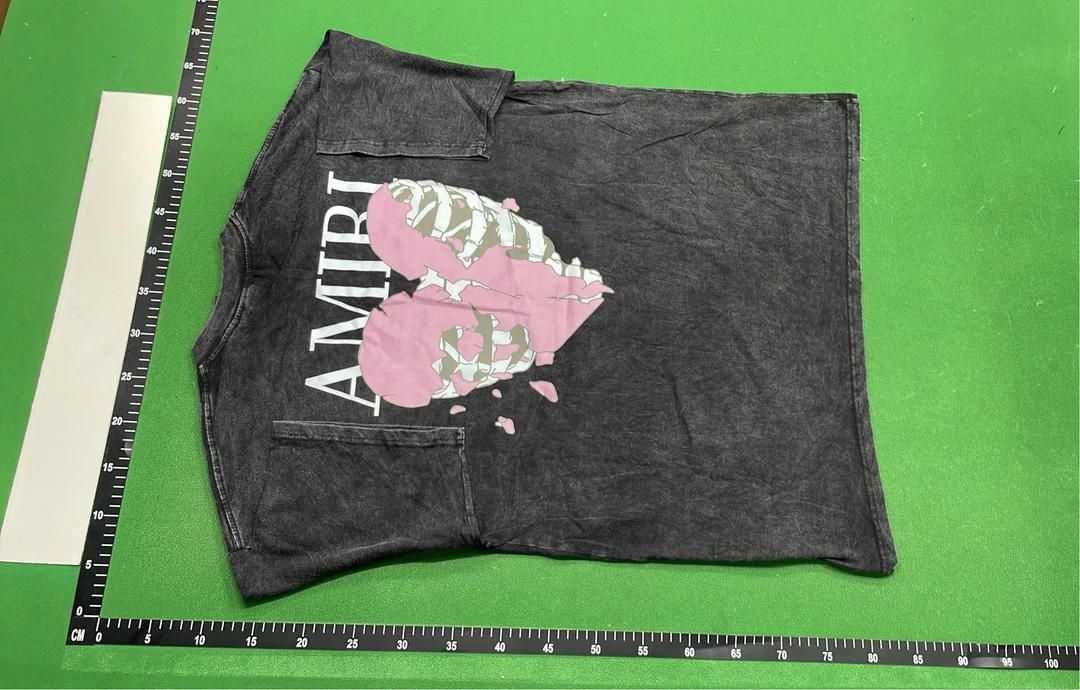
In this community QC photograph, inspected on 27 September 2026, the shirt is spread out to show a large pink graphic and lettering. This view answers a different question from a folded front photograph: it reveals the arrangement of the visible back design. Creases and the camera angle still affect its appearance, so a small apparent alignment difference would need a closer, square-on view before being called a defect.
The source is a public T-shirt QC post in the OopBuy Reddit community. The image illustrates checking another surface of a garment; it is not QC for the OopBuy floral-lightbulb shirt, a verification of brand authenticity or an account of wearing this item.
Keep the conclusion within the image
Lighting and screen rendering can affect perceived colour. A sharp photograph does not establish fabric feel, durability after washing or hidden construction. A picture of several pieces establishes only what is visible in that frame, not necessarily the completeness of the whole order.
For dimensions, follow the size guide. Do not convert a cropped tape reading into a confirmed full measurement when its starting point is hidden. Keep chart information separate until you know that both sources concern the same option and method.
Separate warehouse checks from functional testing
OopBuy's inspection notice in an archive saved on 10 September 2026 distinguished basic product checks from specialist assessment. It excluded assessment of quality, model and spare parts for products requiring specialist knowledge, including electrical and digital goods. For some sealed categories it described an external appearance check rather than opening the packaging. A warehouse image therefore cannot be treated as a powered-on test, a verified set of internal components or proof that a device works. Confirm the actual service available before relying on any such test for a purchase.
Ask for a useful next view
Tell support which item and detail you mean, and what uncertainty you want resolved. Check which photo or measurement options are actually available for your order before assuming an extra image can be supplied or that it is free.
After a response, compare it with the original question. A clearer picture of the front print does not also resolve sleeve length. Record the answered question without treating every other property as checked. Order status and warehouse information remain separate from the visual conclusion.
Share without changing the evidence
Remove personal information, account details, addresses and private identifiers from public copies. Retain enough context to explain what the image shows, and do not alter the feature being discussed. In a review, distinguish the visible observation from any later experience of wearing the item; one cannot be invented from the other.